
‘Together Forever’ Director Gregory Barnes, Cast Lindsey Normington & Samuel Sylvester Talk Sundance Mormon Romance Short Film
Director Gregory Barnes decides to offer his own spin on being together forever in his new Mormon-inspired romance short film. Read our Together Forever interview.

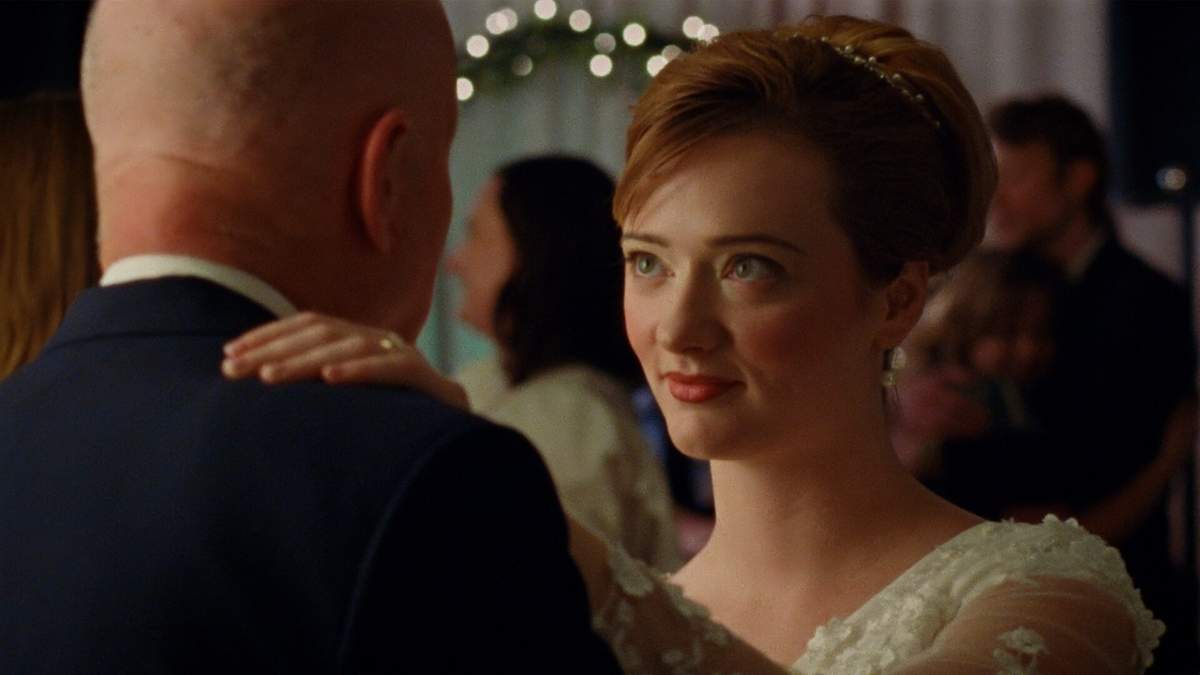
“Together Forever” sounds like such a heavenly prospect for the romantics at heart. But not everyone feels that way. Some may argue it is daunting to imagine being stuck with a person for eternity. At least that’s what the concept of forever seems to mean. Director Gregory Barnes decides to offer his own spin on such a dynamic in his new Mormon-inspired romance short film that walks a fine line between comedic and carrying tragic undertones. Read our Together Forever interview.
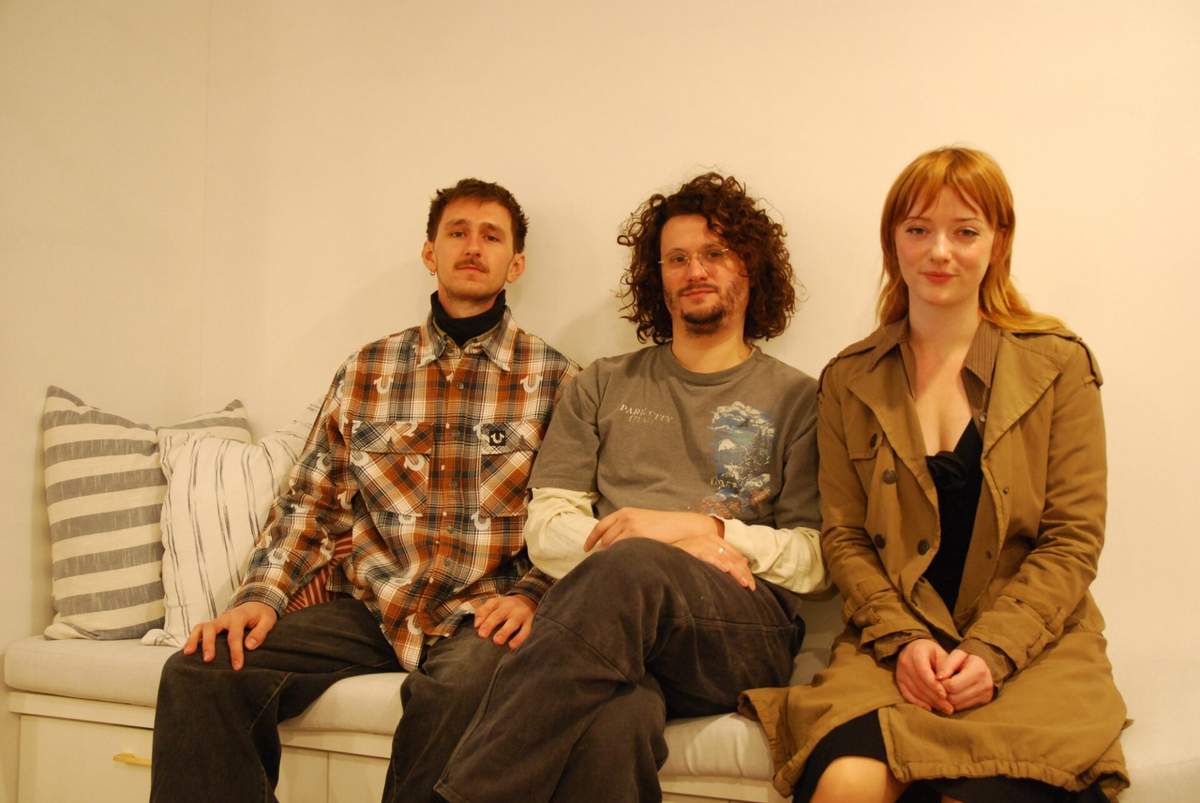
I sat down with the film team: director Gregory Barnes; star Lindsey Normington (from Oscar winning film Anora); and returning collaborator Samuel Sylvester, to discuss their latest project that was part of the short film selection in the most recent edition of Sundance Film Festival, having its last presentation at Park City, Utah before it moves onto Boulder, Colorado next year. We focus on relationships, religion, the fleetingness of life and what to expect from this great experiment on Mormon culture on love and understanding.
Zak Ahmed: What is the most exciting prospect of being together forever?
Gregory Barnes: The most exciting thing about being together forever? I think being together forever would be a curse. I’m a romantic, I believe in love but I’m terrified of my Mormon upbringing and the concept of being tethered to something forever. I think it’s very good to die.
Samuel Sylvester: I think I feel the same way as Greg a little bit. I grew up with a Catholic instead of Mormon upbringing but similar senses of eternal damnation and the like.
Greg: We’re both single, though, so maybe this is revealing too much about us haha.
Lindsey Normington: I’ll offer a counterpoint as I’m not single. I think they can’t really be together forever in the sense of together in love, and that’s a big conflict in the story. But together forever in friendship and companionship is nice. So I think that might be the best thing that could happen for them. But wait and see how Greg could expand the story.
As this is a short, are you hoping to develop it into a feature, or is there a specific reason you wanted to tell your story in this way?
Greg: I think shorts are kind of their own thing. So I really wanted to make this movie. It’s kind of been haunting me for a while. Just the idea of Mormons on their wedding night is already jam-packed with a lot of dramatic tension and I think there’s something very sad about these two characters where they’re trying to be intimate with each other, but they’re not being honest. And whenever you’re not being honest with your significant other, then you can never truly connect. There’s always going to be this barrier. So I think those are the themes that I wanted to explore, and I will probably be making movies about this stuff my whole life, I don’t know. I’m kind of addicted to it.
Why does it haunt you?
Greg: I grew up Mormon. So it’s just my upbringing and the way I’m wired. But I just feel like, whether it’s Mormonism or not, I think these are things that we all struggle with relationships and love. I think there’s nothing better than love. Making movies about that is good, but it’s not so clean. It’s difficult.
With your characters Caleb (Samuel) and Sydney (Lindsey), how did you develop a relationship and chemistry with each other, knowing that it’s a short film, yet it’s talking about the concept of eternal life itself?
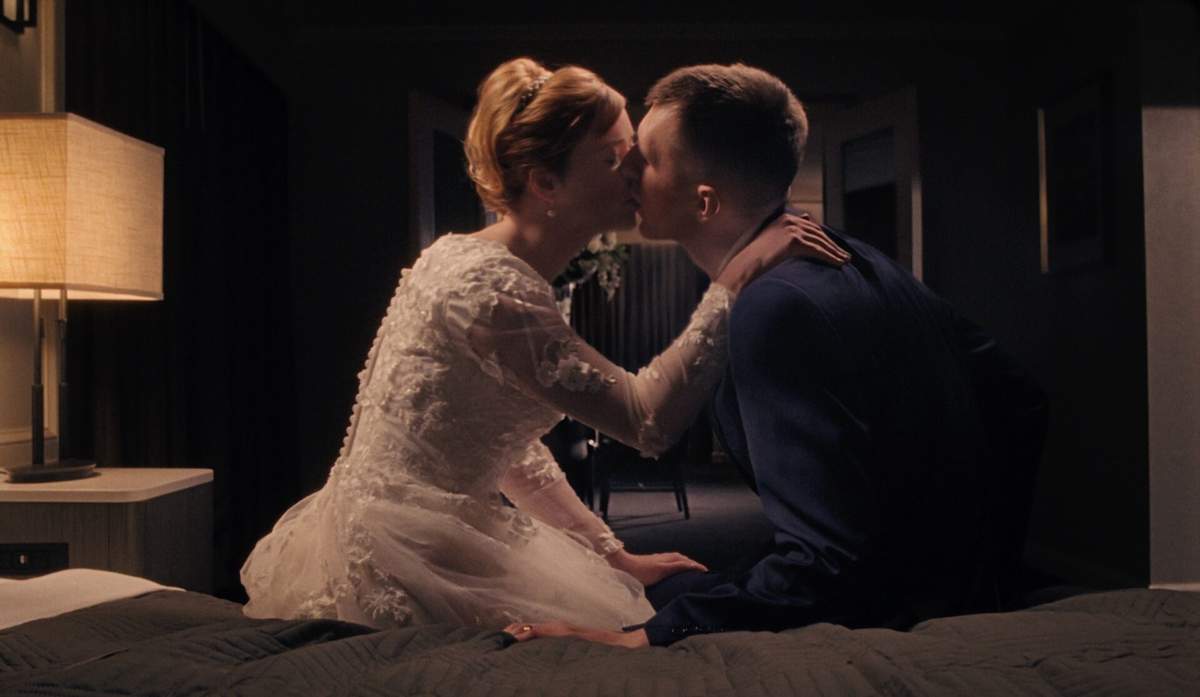
Lindsey: Well, it’s funny because we didn’t really have much of an opportunity to meet before our shoot day, but I think that lent itself to the awkwardness and the tension that these characters are experiencing with each other. Reaching this level of intimacy or attempting to for the first time. I think the first thing we shot was us kissing on the bed. And I think that was very intentional on Greg’s part to just jump right into that. We’re fortunate with this script, where you want to do chemistry reads and make sure that it flows really easily between two people. This was something where we had a lot of space to be awkward with each other. And I feel like we ended up being good friends and having a similar sense of humor, but I think we benefited almost from not knowing each other and not having that at the very beginning when we were shooting.
Sam: I’m also not an actor. I’ve only acted for Greg. I think that lent itself to the awkwardness as well because I’m not used to being on camera, especially not doing things like this on camera. So I think when that’s the first thing you do when you meet a person is kiss on a bed on camera. It’s just inherently awkward, especially since I’m not used to, I’m not in the film world at all really. I’m a graduate student. Like Lindsey said, we just ended up having a similar sense of humor. Yeah, I don’t know.
There was a film that came out last year called Die My Love. I remember one of the things Jennifer [Lawrence] and Robert [Pattinson] talked about that the first scenes was stripping nude together. It broke the ice and made them feel comfortable straight away because they, already shed the awkwardness. I think it’s a smart call you made. To Lindsey, congratulations on Anora winning the Oscar. What is the difference in playing a character like Diamond compared to Sydney?
Lindsey: No, it’s incredibly different. That’s one thing about this script that was really exciting for me when Greg approached me. I tend to play a lot of sex worker characters. A lot of tough or mean types of girls. That’s just one thing I’ve been offered a lot. But when Greg approached me with the script, I was really touched because this is someone who is so sweet, innocent and bubbly. I just feel that people don’t normally see that side of me as easily, but that’s as much a part of me as all the other sides. So I felt very honored that he saw that in me and working on it, it’s easy for me to access those parts of myself. Then I think the thing that was maybe more of a challenge was understanding a little bit more about the culture. It’s not something I have experience with, but Greg offered me a lot of his own experience and then a lot of resources, it’s so diverse, the spectrum of Mormonism. There are so many different perspectives that he shared with me and luckily there’s so much amazing content online. I think it’s really cool to see testimony and I don’t know if you use the word like evangelism, but trying to bring more people into the faith is such a big part of Mormonism that it’s extended into social media. We assume that people are going to go door to door, but now they’re reaching people through all these things. He gave me so much to look at. So it was really helpful.
You revealed a side to yourself that people don’t often have access to on screen. Did that make it more of a challenge to finally uncover that layer or did it feel like a moment of relief to show that there’s more complexities that people were not anticipating with your performance?
Lindsey: Both for sure. I think what was a relief and simple for me was leaning into innocence, sweetness, hope and desire in this really pure way. What actually was challenging for me is I’m very used to being sexualized and put in sexual positions in material. But this was something where my character was very unsure of herself sexually and had a lot of wants and desire, but was very awkward and doesn’t really know what she’s doing. So I don’t normally lean that way, and I feel normally that I’m this aggressor or very sure of herself, sexy woman. I had to let go of the sureness around that.
I think you did a great job.
Lindsey: Thank you.
Do you remember your first canon film memory?
Lindsey: I actually don’t remember this but I’ve been told that I was taken to see Mulan in the movie theater and that was the first movie that I saw. After she sang the reflection song, I clapped and went, yay. I like that story. I don’t remember it, though. I don’t know if it’s true.
Greg: I think the film canon starts with Home Alone and I watched that movie so much as a kid, and I wore out the VHS tape and broke. But I was watching that movie before I could speak. I’d waddle up to my mom and be like, home, home, home. And she was like, oh, he wants to watch this shit. I love Macaulay Culkin.
Sam: I feel like the first movie that really made a big dig into me was Jesus Camp. It’s a documentary about an evangelical youth camp. Love it.
You mentioned evangelism and this film is about Mormon culture. With the modern digital space and how secular Western society has become in terms of relationships, marriages are no longer what they used to seem like, how do you feel about that transition when you’re rooted from religious backgrounds?
Greg: I think that’s a difficulty in the modern age. We’re just being pushed to be individuals right now and I hear a lot of yearning from a lot of people for community and collective action and it’s very difficult because I think we’re all being splintered online. There’s a lot of really messed-up stuff happening right now, and it’s really hard to actually come together and organise because I think of the splintering. Specificall,y what you’re talking about with relationships, traditions and expectations. It’s sort of these two opposite poles that are now pulling us. We have individualism and this tradition. I think what’s important is to develop a sort of individuality that can hold both of these polar opposites, that tension. If you can hold that tension together, that’s the key. But it’s not an easy thing.
Sam: I also think in terms of religiosity, younger generations are more religious than the millennial generation. So I think it comes and goes in waves. So we’ll see how that pans out with time to come.
Lindsey: I agree with a lot of what Greg was saying. I think one thing that is so exciting to come to a festival with a film like this and then as I got closer to it, it felt like such a privilege to do this and then stepping away from everything back home in LA is really troublesome. And so it’s kind of an internal conflict, but I think we can use film to push towards individualism and separation or use it toward collectivism. I feel like I’ve already seen some great projects dealing with that here already, that’s given me some hope and I think it’s really beautiful universal themes in this too that makes me proud to be a part of that.
What do you hope for viewers at home or in theatres to extrapolate from the film, where they’re internalising the process of an ephemeral, temporary life, yet your story is talking about something that feels eternal?
Greg: It’s funny, I think there’s sort of this didactic nature to religion or making movies about religion and spirituality. The movie’s saying something about being genuine to who you are and thinking about the consequences, but really, I see the movie as something very beautiful that Caleb really wants to make Syd happy on her wedding night. And that’s a very beautiful thing to try to make someone happy and to give someone that gift. The tragedy comes from the fact that Caleb is closeted and he sort of hates himself, so I think just trying to tap into who you are and being brave enough to put yourself out there. Mormonism is a pressure cooker, that’s why I make movies about it because it’s just this thing that always cooks. That’s what I hope people get out of it.
Together Forever premiered at the Sundance Film Festival.
Thanks for reading this Together Forever interview. For more, stay tuned here at Feature First.